Stakeholder Engagemnet
- Stakeholder Identification
Based on the company’s operational characteristics and through cross-departmental discussions, Sino-American Silicon Products Inc. has identified seven major categories of stakeholders, including employees, customers, shareholders (investors), suppliers (contractors), government agencies (Science Park Bureau, Department of Environmental Protection, Environmental Protection Administration, Bureau of Energy, Ministry of Labor, etc.). They engage and communicate through various channels, both regularly and irregularly, to understand stakeholders’ expectations. This also serves as a source of information for assessing sustainability issues and impacts.
- Stakeholder Communication and Response
SAS has established all kinds of communication channels in its daily operations to maintain inter-communication with stakeholders. A mailbox and a customer service hotline for external communication have also been set up on the company website to collect opinions of our primary stakeholders related to our management & activities, i.e. investors, customers, media and so on.
- Identification and Analysis of Material Aspects
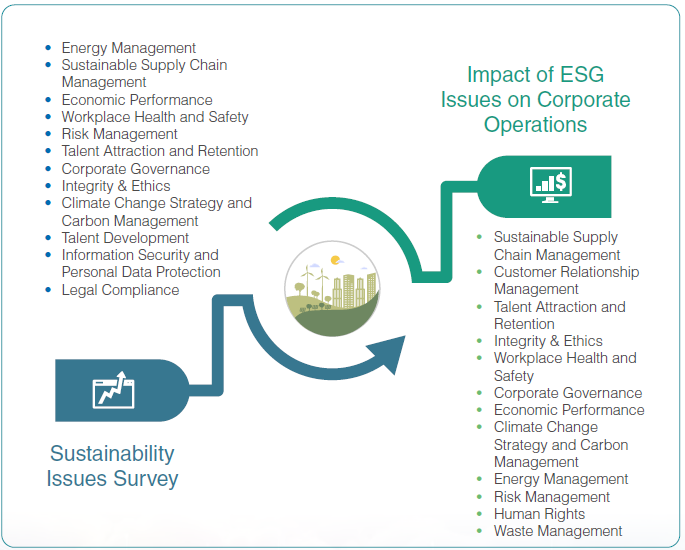
Following a four-phase process in accordance with GRI 3 Material Topics 2021, SAS has redefined the methodology for identifying material topics. Based on the “level of concern” and “degree of impact” on sustainability topics as the materiality evaluation principles, SAS identifies and evaluates material issues in the areas of governance, economic, environmental, and social (including human rights) dimensions. Ultimately, sustainability issues are ranked based on the significance of their impact. The top 10 material topics will be reported in this report, and management policies and targets will be set for regular monitoring. Other material issues will also be reported in this report, but management policies and targets will not be set, and they will only be monitored continuously. SAS will implement this materiality identification process once every three years (or when the Material Topic Standards are revised and updated) to regularly review the impacts of these issues.
| Primary Stakeholders | Significance to SAS | Communication Channel | Communication Frequency | Issues of Concern |
|---|---|---|---|---|
| Customers | Company’s main source of revenue. | Business Meetings | Irregular | 1. Information Security and Personal Data Protection 2. Integrity & Ethics 3. Workplace Health and Safety |
| Customer satisfaction survey | Twice a Year | |||
| Customer audit | Irregular | |||
| Customer questionnaire | Once a Month | |||
| Appeal / complaints telephone or email | Irregular | |||
| Employees | Employees are the company’s most important assets. Only by taking good care of the employees will both parties grow in sync with each other. | Internal website and emails | Irregular | 1. Talent Attraction and Retention 2. Talent Development 3. Workplace Health and Safety |
| Company notice board | Irregular | |||
| Labor-management consultation meetings | Four meetings per year | |||
| Complaint boxes or hotlines | Irregular | |||
| Performance appraisal interviews | Once a year | |||
| Employee Satisfaction Survey | Once a year | |||
| Various Organization Meetings | Irregular | |||
| Shareholders / Investors | All shareholders are the company’s investors. The company will handle all disclosed information with fairness as the principle. | Shareholders meeting, institutional investors conference, domestic investment institute seminars and face-to-face communication meetings. | A total of 6 institutional investors conferences in 2025. | 1. Economic Performance 2. Corporate Governance 3. Sustainable Supply Chain Management 4. Climate Change Strategy and Carbon Management |
| Company annual report | Once a year | |||
| News announcement on company websites and the market observation post system | Irregular | |||
| Collecting and replying to messages via telephone or emails | Irregular | |||
| Suppliers / Contractors | Are the company’s partners and need to maintain the same ideals as ours in order to provide services in line with our needs. | Business Meetings | Irregular | 1. Information Security and Personal Data Protection 2. Suppliers / Contractors Management Regulations |
| On-site audit | Irregularly on an annual basis |
|||
| Collecting and replying to messages via telephone or emails | Irregular | |||
| Governmental institutes (Mainly the science park bureau, environmental protection bureau, environmental protection administration, energy conversation bureau, ministry of labor and so on) | We need to main an open and pleasant communication relationship to express our determination of complying with regulations. | Correspondence of official documents, meetings (public hearings or conferences) | Irregular | 1. Energy Management 2. Climate Change Strategy and Carbon Management 3. Workplace Health and Safety |
| Communicating by meeting with associations or unions | Irregular | |||
| In-Factory Audits | Irregular | |||
| The media | We establish a contact channel with the media and provide non-scheduled, correct, fair and objective industry and corporate news. | Releasing news We sporadically receive interviews by the media and provide industry news. | An average of 2-3 pressure releases every quarter | 1. Company development direction 2. Economic Performance |
| Community (social welfare organization, neighborhood, NGO) | 1.Work with local public welfare groups or rural schools to provide financial assistance to disadvantaged groups and units with limited resources. 2.Organize environmental protection activities from time to time, contribute to the environment, and assist local environmental protection units and groups to jointly maintain the environment. | The Group's personnel actively participating. | Twice a year | 1. Charitable organization projects, such as public-interest science education camps 2. Enhancing education and implementing infrastructure improvements for rural schools |
Identification
Sustainability Context
We follow GRI standards
and disclose our
economic, environmental
and people(including human rights) improvements
and performance.
Prioritization
Materiality
The report has collected stakeholders opinions or issues of concern for ESG committee to identify their importance.
Verification
Completeness
Major topics and their scope, boundary and timeline are confirmed.
Report
Stakeholder Inclusiveness
We communicate with stakeholders and respond to their reasonable expectations
Review
Sustainability Topics
Stakeholder Inclusiveness
Sources
| International Sustainability Standards and Regulations | Sustainable Development Goals (SDGs) | Responsible Investment | Industry Development Trends | Issues of Concern to Stakeholders |
|---|---|---|---|---|
| With reference to international sustainability standards such as the GRI Sustainability Reporting Standards, the Responsible Business Alliance (RBA), the Task Force on Climate-related Financial Disclosures (TCFD), the Carbon Disclosure Project (CDP), and Sustainability Accounting Standards Board (SASB) | Evaluate the 17 SDG goals and their 169 targets, and select actions where SAS can contribute | With reference to rating indicators such as the Dow Jones Best-in-Class Indices (DJ BIC), MSCI ESG Leaders Indexes, and FTSE4Good Index | Sustainability issues of concern among international sustainability leaders, the information technology industry, and other cross-industry sectors | Key sustainability topics of concern to stakeholders include business ethics and integrity, sustainable supply chain management, energy management, and talent attraction and retention. |
Assess the significance of impact
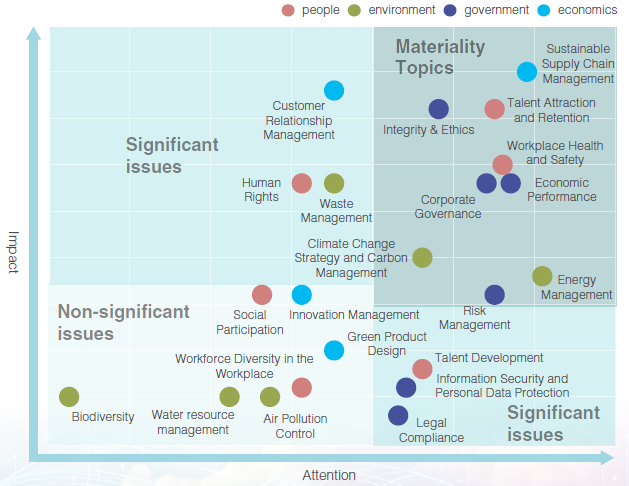
The questionnaire data includes three parts: the level of concern, the likelihood of occurrence, and the severity of the impact assessment. The impact assessment and level of concern are analyzed statistically, and based on the analysis results, a materiality matrix is drawn (as shown in the figure). Issues with high concern and high impact are categorized as material issues. After consolidation, there are 16 issues with higher significance.
Prioritize the most significant impacts
Finally, the significant impact of SAS’s material topics for 2023 is ranked. The top 10 issues are to be reported in this report, with management policies and goals set for regular tracking and management. Other issues are disclosed in the summary or not
included in this report.