
Sustainability Environment
Sustainability Environment
- Climate Change Risks and Actions
- Carbon Emissions Management
- Energy Management and Renewable Energy
- Water Resource Management
- Biodiversity Actions
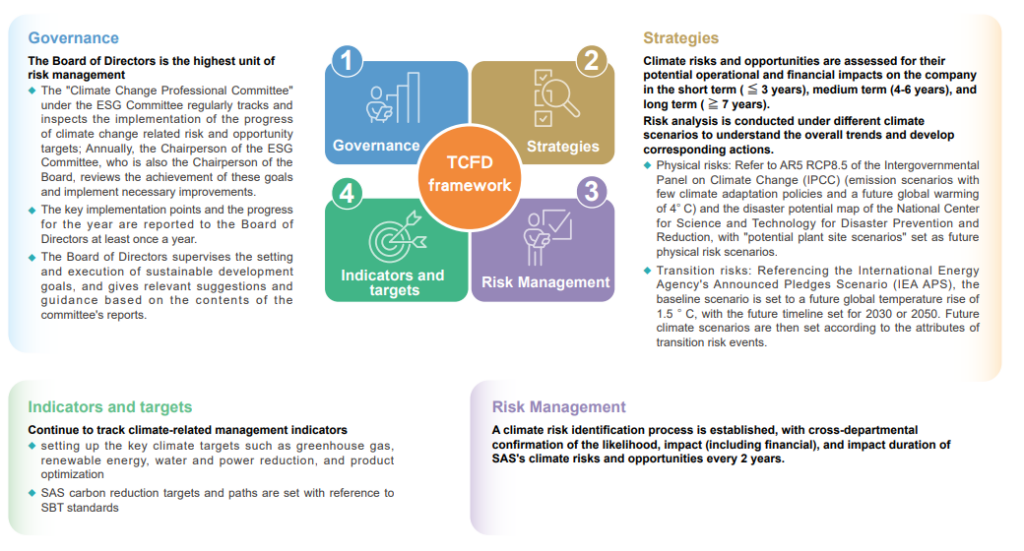
Driven by the increasing frequency of extreme weather events worldwide and the accelerating transition toward a low-carbon economy, SAS closely monitors the risks and opportunities associated with climate change. Drawing on the recommendations of the Task Force on Climate-related Financial Disclosures (TCFD), we have established our own climate risk and opportunity assessment framework. Through cross-functional collaboration, we identify and evaluate current and emerging climate-related factors, including regulatory and policy developments, technological advancements, market changes, reputational impacts, and physical risks. This assessment process enables us to better understand external environmental and market dynamics and to integrate climate-related considerations into our overall business strategy and operational planning.
- Governance Structure and Responsibility
SAS recognizes climate change as a material operational issue. In terms of climate governance and oversight, the Board of Directors serves as the highest governing body. To ensure the effective implementation of climate strategies, the Board delegates specific oversight responsibilities to its functional committees according to their respective authorities, as outlined below:
- Board of Directors: Serves as the highest decision-making body for climate governance. Establishes the Company’s Risk Management Policy and Procedures. Supervises and approves the Group’s overall climate management strategies, mechanisms, and vision. Regularly reviews the effectiveness of climate strategy implementation.
- Nomination and Sustainability Committee: Oversees sustainability and climate strategies. Formulates specific policies and monitors progress toward sustainability and climate objectives. Provides comprehensive oversight of Environmental, Social, and Governance (ESG) matters. Responsible for the nomination, succession planning, and performance evaluation of directors and senior executives.
- Audit Committee: Oversees the Group’s business operations and financial condition. Ensures compliance of climate-related disclosures with applicable domestic and international standards and regulations.
- Remuneration Committee: Responsible for evaluating the remuneration of senior management. Incorporates ESG and climate-related performance indicators into remuneration assessments.
- Risk Management
The Board of Directors is responsible for risk governance and authorizes the Audit Committee to review the Company’s business operations and financial condition, including ensuring compliance of climate-related disclosures with applicable domestic and international standards and regulations.
The Sustainability Development Committee, operating under the Nomination and Sustainability Committee, is responsible for managing and implementing climate- and environment-related sustainability initiatives. Its responsibilities include developing the Company’s climate change targets, strategies, and action plans, as well as managing climate-related risks and opportunities. The scope of risks considered includes, but is not limited to, carbon-related policies and regulations, natural disasters, and water resource utilization, as well as other potential risks that may affect the Company’s operations and supply chain.
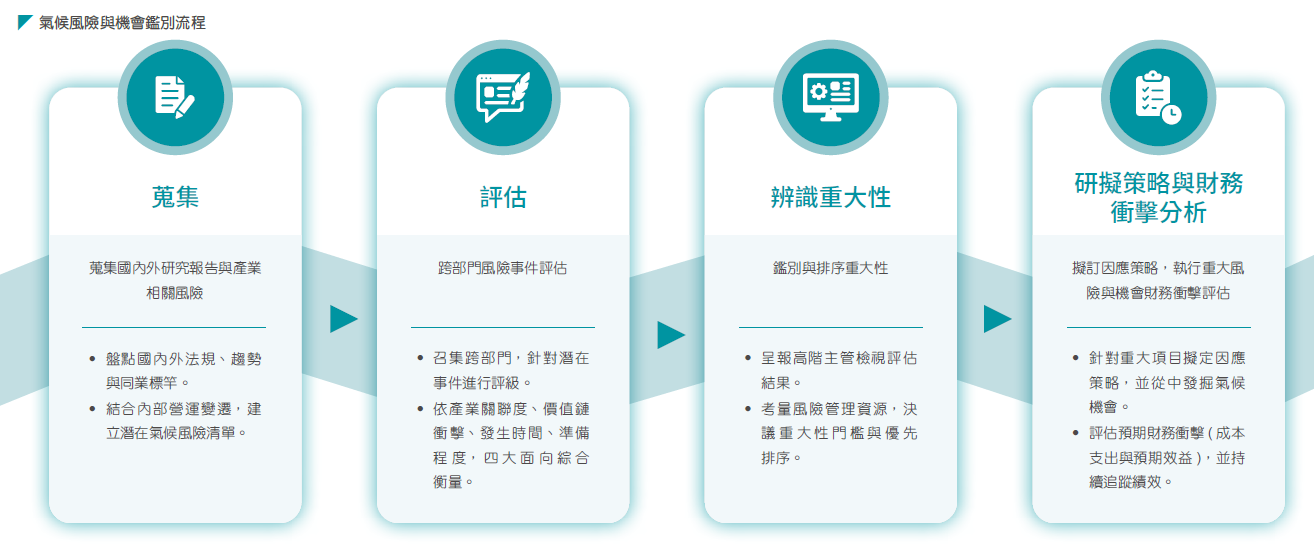
In response to the challenges posed by climate change, SAS conducts climate-related risk and opportunity identification and assessment every two years with reference to the requirements of IFRS S2. Through scenario analysis and financial impact quantification, the Company develops appropriate response strategies and mitigation measures.
- Science-Based Targets (SBTi) and Net-Zero Transition Pathway
To support the global ambition of limiting temperature rise to 1.5°C, SAS has successfully obtained validation from the Science Based Targets initiative (SBTi), ensuring that its decarbonization pathway is aligned with internationally recognized scientific standards. Using 2022 as the base year, the Company commits to reducing its absolute Scope 1 and Scope 2 greenhouse gas emissions by 63% by 2035. For Scope 3 emissions, using 2024 as the base year, the Company commits to reducing absolute emissions by 37.5% by 2035 across key categories, including Purchased Goods and Services, Capital Goods, and Fuel- and Energy-Related Activities.
To achieve these short-, medium-, and long-term targets, the Company focuses on the following three key decarbonization pillars:
- Energy Efficiency Improvement: Continue implementing lighting system upgrades, cooling water temperature optimization, and replacement of aging high-energy-consuming equipment, including motors, cooling tower fans, and thermal insulation materials used in crystal growth furnaces. Future plans include the installation of high-efficiency chillers and upgrades to the Energy Management System (EMS), which are expected to reduce chiller energy consumption by approximately 30%. In addition, optimization of air compressor system configurations is expected to further reduce energy losses by approximately 15%.
- Renewable Energy Adoption: Leverage the Group’s long-term investments in solar photovoltaic and offshore wind energy by adopting a diversified Power Purchase Agreement (PPA) strategy. Through joint procurement agreements with renewable energy developers and international partners, the Company plans to progressively increase the proportion of renewable electricity consumption and steadily advance toward its goal of achieving 100% renewable electricity use (RE100) by 2050. The Company will continuously adjust PPA procurement volumes based on operational requirements and supplement renewable electricity sourcing with Renewable Energy Certificates (RECs) and carbon credit purchases to support its net-zero transition pathway.
- Value Chain Engagement (Scope 3 Emission Reduction): Launch supplier engagement programs and formally incorporate carbon management performance into supplier evaluation criteria. Guided by the principles of energy security, affordability, and sustainability, the Company seeks to integrate low-carbon manufacturing processes and circular economy practices while collaborating with upstream and downstream partners to build a climate-resilient net-zero supply chain.
Since 2021, SAS has progressively established and completed a systematic greenhouse gas (GHG) inventory and emissions database. The reporting boundary covers the Headquarters, Chunan Branch, and Yilan Branch, and also includes Sunrise Subsidiary and SGE Hsu-Hsin Branch, which were restructured from branches into subsidiaries during the 2025 reporting period. As 2025 marks the first year in which SAS conducted a comprehensive inventory of Scope 1, Scope 2, and Scope 3 greenhouse gas emissions in accordance with the GHG Protocol and obtained third-party verification, the Company has designated 2025 as the baseline year. To monitor greenhouse gas emission trends and evaluate the effectiveness of emission reduction initiatives, greenhouse gas emissions data from 2021 to 2024, prepared in accordance with ISO 14064-1:2018, are also disclosed as trend references.
The Company adopts the operational control approach to define its organizational boundary. The inventory scope includes both direct greenhouse gas emission sources (Scope 1) and indirect greenhouse gas emission sources (Scope 2 and Scope 3). Greenhouse gases covered by the inventory include seven categories: carbon dioxide (CO₂), methane (CH₄), nitrous oxide (N₂O), hydrofluorocarbons (HFCs), perfluorocarbons (PFCs), sulfur hexafluoride (SF₆), and nitrogen trifluoride (NF₃). The primary quantification method applied is the emission factor approach. Emission factors are mainly referenced from the Ministry of Environment’s Greenhouse Gas Emission Factor Management Table (Version 6.0.4, June 2019), the Ministry of Environment’s Carbon Footprint Calculation Service Platform, the Ecoinvent database, and relevant literature. Global Warming Potential (GWP) values are based on IPCC AR6 (WG1, 2021). The greenhouse gas emissions identified through this inventory primarily comprise CO₂, CH₄, N₂O, and HFCs, while no greenhouse gas emissions from PFCs were identified.
- Scope 1 and Scope 2
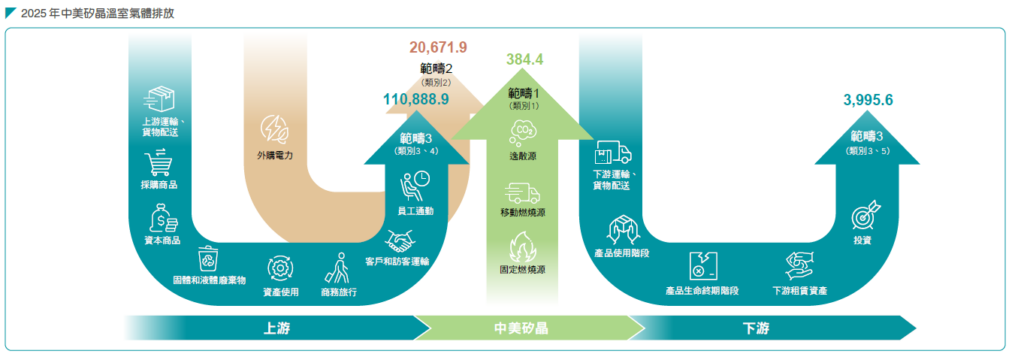
In 2025, SAS reported 384.4 metric tons of CO₂e for Scope 1 (direct greenhouse gas emissions) and 20,671.9 metric tons of CO₂e for Scope 2 (indirect greenhouse gas emissions from purchased energy). Overall, combined Scope 1 and Scope 2 emissions totaled 21,056.3 metric tons of CO₂e, representing a 20.5% decrease from the previous year and a 58.6% reduction from the 2022 target base year. These results demonstrate the Company’s continued commitment to greenhouse gas inventory management and carbon reduction initiatives, resulting in ongoing improvements in overall emissions performance.
To enhance year-on-year comparability and more accurately assess the effectiveness of operational improvements and carbon reduction measures, the Company additionally conducted a comparative analysis of Scope 1 and Scope 2 emissions using the 2024 electricity emission factor as a consistent basis. Based on this consistent emission factor, combined Scope 1 and Scope 2 emissions in 2025 decreased by 17.2% from the previous year and by 55.7% from the 2022 base year. (For reference, the recalculated combined Scope 1 and Scope 2 emissions under the same basis amounted to 25,432.5 metric tons of CO₂e in 2024 and 47,560.7 metric tons of CO₂e in 2022.)
In 2025, SAS recorded a Scope 1 and Scope 2 emissions intensity of 6.38 metric tons of CO₂e per NT$1 million of revenue, representing an increase from the previous year. Emissions intensity reflects not only greenhouse gas performance but is also influenced by operational factors such as revenue scale, product mix, and capacity utilization. Although total Scope 1 and Scope 2 emissions decreased in 2025 compared with the previous year, revenue declined at a greater rate than emissions, resulting in an increase in emissions intensity. Looking ahead, the Company will continue implementing energy conservation and carbon reduction measures while further strengthening emissions intensity management through improvements in operational efficiency and low-carbon management practices.
- Scope 3
In 2025, SAS reported 114,884.489 metric tons of CO₂e for Scope 3 (other indirect greenhouse gas emissions), representing a 58.2% decrease compared with the previous year, which also serves as the Scope 3 emissions reduction baseline year (2024). The decrease in emissions during the reporting year was primarily attributable to lower raw material demand and corresponding reductions in upstream emissions resulting from production capacity adjustments at certain facilities. In addition, the Company continued to promote supplier carbon management through its procurement practices by encouraging suppliers to establish product carbon footprint data. For certain raw materials, supplier-provided product carbon footprint data were adopted as emission factors, enabling Scope 3 emissions calculations to more accurately reflect actual supply chain conditions. Overall, the change in Scope 3 emissions during the reporting year was mainly influenced by changes in business activity levels and updates to certain emission factor data sources.
- Energy Management
SAS’s energy consumption encompasses electricity, diesel, and gasoline, with electricity comprising the majority share. Accordingly, energy conservation initiatives should be prioritized, and any proposed solutions must fulfill the criteria of being Safe, Affordable, and Sustainable (SAS) to be considered optimal energy strategies.
Previous energy conservation efforts in the factories were primarily one-time initiatives, which may not have achieved optimal energy savings due to the absence of a formal management framework. Since 2021, SAS has applied the Energy Management System (ISO 50001:2018) across its manufacturing sites. Both the Chunan Branch and Sunrise Subsidiary currently operate under a systematic PDCA (Plan-Do-Check-Act) management cycle. This approach includes assessing equipment energy consumption within facilities to identify significant energy users and those needing improvement. Identified devices are regularly monitored and measured, with specific action plans developed for efficiency enhancements. Energy baselines and performance indicators are established according to each plant’s features and energy use analysis, and these metrics are reviewed monthly for relevance and accuracy as part of ongoing energy efficiency assessment.
- Renewable Energy
Most of the electricity generated by SAS’s solar power generation systems is sold. In 2025, electricity sold amounted to 1,759,796 kWh (6,335 GJ). To actively fulfill its carbon reduction commitments under RE100 and SBTi, SAS regards energy transition as a core strategy. Through diversified approaches such as signing renewable energy power purchase agreements (PPAs) and procuring renewable energy certificates (RECs), SAS is gradually increasing the proportion of green energy use. For SAS’s short-, medium-, and long-term renewable energy targets and specific pathways, please refer to the “Climate-Related Risk and Opportunity Metrics and Targets” section under “Climate Strategy and Actions.”
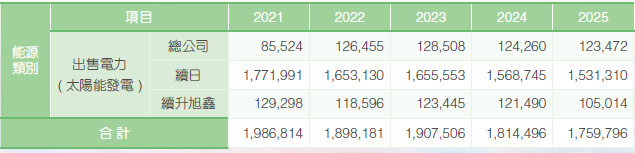
Unit:kWh
- Water Resource Management and Conservation
In recent years, affected by climate change, the temporal and spatial distribution of rainfall in Taiwan has become increasingly uneven, and drought and flood conditions have tended to become extreme, bringing challenges to overall water supply stability and industrial operations. Facing the situation of rising water resource risks, the Company continues to strengthen its water resource management strategies, incorporates water conservation and recycling use into key points of operational management, and prudently responds to the impacts of climate change on water resource supply and demand.
In terms of promoting water conservation, SAS reduces the water use intensity per unit product through process optimization, equipment efficiency improvement, and refinement of water use monitoring mechanisms; at the same time, it actively introduces water recovery and reuse technologies to increase the process wastewater recovery rate and system recycling utilization rate, in order to reduce reliance on tap water and surface water resources.
In addition, SAS regularly reviews the water use performance and improvement results of each plant area, and continues to invest resources in the research and development of water conservation technologies and the optimization of management systems, to ensure the stable improvement of water resource use efficiency. Through the above measures, SAS demonstrates its commitment to sustainable water resource management, and creates value with both environmental and economic benefits for environmental protection and long-term corporate development.
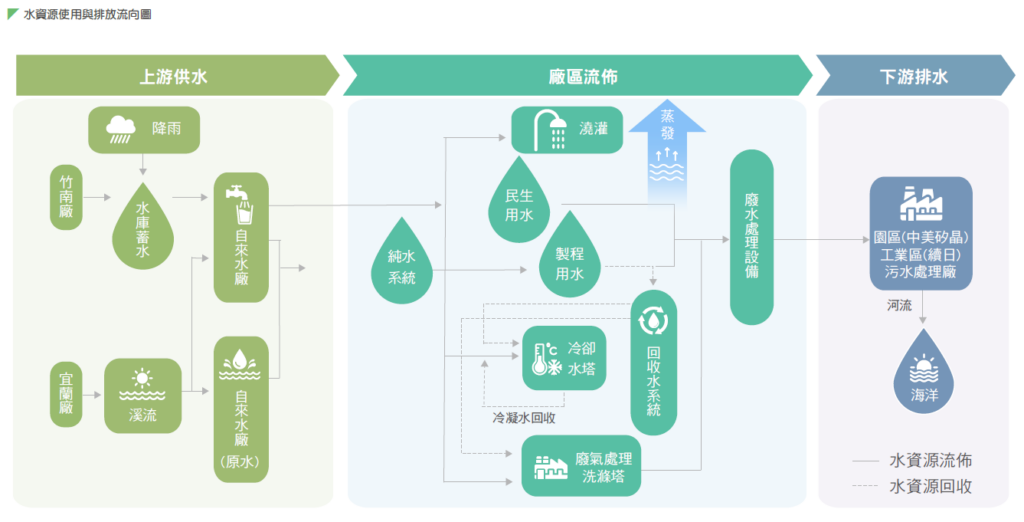
Based on the quality requirements of SAS’s products and manufacturing processes, SAS uses purified water rather than ultra-pure water (UPW). Therefore, ultra-pure water usage was 0 m³ from FY2022 to FY2025, with 100% coverage.
- Water Sources and Water Stress Assessment
The operational water use of each SAS plant area is applied for from public departments in accordance with law. The water sources are taken from tap water supplied by Taiwan Water Corporation and surface water systems, and groundwater resources are not used; therefore, there is no risk of groundwater over-extraction, land subsidence, or damage to regional hydrology and ecological environment. Through compliant water withdrawal and stable water supply management, the Company ensures the balance between production operation and environmental protection.
The tap water supply source of the Chunan Branch is Dongxing Water Treatment Plant, and its raw water is taken from Yongheshan Reservoir. The above-mentioned raw water sources are not located within the scope of national or international nature reserves, nor do they belong to water bodies with high ecological sensitivity (for example, with special area or functions, rare, threatened, or endangered ecosystems), and they also do not involve waters inhabited by endangered species.The Company continues to pay attention to the environmental status of water sources and water supply stability. Through water resource risk inventory and compliance management mechanisms, it ensures that water withdrawal behavior complies with relevant laws and regulations, while also being committed to improving water use efficiency and recycling utilization rate, reducing reliance on natural water bodies and environmental impacts, and moving toward the goal of sustainable water resource management.
Referring to the Aqueduct water resource risk assessment tool, Taiwan’s overall water resource risk belongs to level 1~2 (low to medium risk), and there are no areas belonging to high water resource stress. Therefore, SAS has no water withdrawal, water discharge, or water consumption from areas with high water resource stress.
- Water Pollution Prevention and Control
In response to the regulations and infrastructure conditions of the locations where each plant is situated, the process wastewater of SAS is respectively discharged into the wastewater treatment plant of the Chunan Park under the Hsinchu Science Park Bureau, Ministry of Science and Technology, and the wastewater treatment plant of the Lize Industrial Park is discharged to the designated wastewater treatment plant for treatment. To maintain the stable and efficient operation of the pollution prevention and control systems, the Company has established a regular equipment maintenance and inspection system, implements preventive maintenance and immediate abnormality handling mechanisms, and assigns dedicated personnel with professional qualifications to conduct operation and management in accordance with standard operating procedures and regulatory requirements, so as to ensure treatment efficiency and discharge quality. In addition, to strengthen real-time monitoring and risk response capabilities, each plant has installed automatic water volume and water quality monitoring facilities before wastewater discharge to continuously monitor key indicators such as pH value and fluoride ion concentration, and conducts regular water quality testing and reporting operations in accordance with regulations. The discharged water quality complies with or is superior to the pipeline discharge standards. Meanwhile, the park management authorities also conduct unscheduled sampling inspections at the discharge outlets, forming a dual supervision mechanism to ensure water quality compliance. In 2025, no major leakage, overflow, or environmental penalty incidents occurred at any plant.
In terms of water pollution prevention and control strategies, the Company upholds the management principles of “source reduction, waste liquid diversion, and classified treatment.” Wastewater is diverted and further classified according to the characteristics of different process wastewater, and is treated separately by the in-plant wastewater treatment facilities based on its water quality characteristics. Each plant has established a comprehensive biological treatment system, combining anaerobic treatment with aerobic treatment, to effectively enhance the removal efficiency of organic pollutants and the overall stability of treatment.
According to the analysis results of wastewater discharge water quality in 2025, the effluent quality met or was better than the applicable sewer acceptance standards prescribed by the Science Park Bureau, indicating that the wastewater treatment facilities operated stably and that the management mechanisms were sound. The Company will continue to refine wastewater treatment technologies and management systems to reduce impacts on environmental water bodies and fulfill its responsibility for sustainable water resource management.
- Policy and Commitments
As a Green Energy Solutions Integrator, Sino-American Silicon Products Inc. (SAS) focuses on renewable energy project development, operations and maintenance (O&M), energy storage, and energy-saving services, and further extends our value proposition to critical materials. In response to the dual crises of climate change and biodiversity loss, and as a driver of the energy transition, we are committed to integrating the principles of Nature Positive and No Deforestation into every decision we make while pursuing business growth. By minimizing our impacts on natural capital across operations and value chain, we are shaping a future where business and nature thrive together.
Our Commitments and Actions:
- Responsible site selection to avoid sensitive areas
During the planning and development of renewable energy projects and operational sites, we prioritize ecological sensitivity assessments. We proactively avoid nationally and internationally recognized biodiversity hotspots and protected areas, preventing adverse impacts on habitats and ecosystems. - Partnering across the value chain to reduce environmental footprint
We promote a green supply chain by working with value chain partners to improve resource efficiency, strengthen pollution prevention and control, prohibit illegal logging activities, and procure materials from sustainable sources. Together, we reduce pressures on forest, protect soil and water, and safeguard wildlife habitats. - Taking action to give back to nature
We support Nature-based Solutions (NbS) and participate in biodiversity-friendly initiatives. Through tangible actions, we contribute to nature and help safeguard local ecosystem services, enhancing environmental resilience and biodiversity. - Deepening renewable energy to generate climate co-benefits
We view our core businesses—renewable energy and energy storage services—as key pathways to biodiversity protection. By delivering clean energy solutions that drive decarbonization, we tackle climate change at its source and help the industry reduce climate-related impacts on ecosystems. - Compliance, transparency, and integrity
We strictly comply with applicable environmental laws and regulations in all locations where we operate, monitor international conservation trends, and regularly review implementation progress. We transparently report on our management performance and uphold our commitment to sustainable operations.
- Biodiversity Actions
According to the query results from the WDKBA geographic information system, none of the Company’s sites are located in Key Biodiversity Areas (KBA).
Follow Our Policy, SAS has planned that in 2026 it will proceed toward two aspects: “environmentally friendly contract farming” and “native species restoration.” Centered on farms, it expects to protect regional species through friendly farming contracts and ensure that habitats do not shrink. In addition, through professional assistance, it plans to plant and restore Taiwan endemic plant species under suitable conditions around the plant areas, with the expectation of maintaining local ecosystems and promoting environmental resilience and diversity.
In addition, the Company regards businesses such as renewable energy and energy storage services as key service pathways for protecting biodiversity. In addition to the Group having announced 2050 RE100 in 2021, it also expects to assist industries in reducing carbon through providing clean energy solutions, and to mitigate from the source the damage caused by climate change to ecosystems. In addition, subsidiary SGE Hsu-Hsin expanded into agrivoltaic and fishery-solar projects in 2025, and obtained the consent of the competent authorities in accordance with regulations. The projects are expected to be completed and begin operations in 2026. To reduce the impact on the environment, mechanical weeding is used instead of chemical weed control during operation and maintenance. In 2025, it also signed the “Self-Regulatory Convention on Solar Photovoltaic Panel Cleaning,” committing that solar modules will be cleaned only with clean water throughout the entire process, and that no chemical agents or cleaning detergents will be used or sprayed. It is strictly prohibited to affect surrounding land, water bodies, and ecological environment, thereby effectively achieving the corporate responsibility of being environmentally friendly. In 2025, an on-site inspection was conducted of the floating solar power plants previously installed and constructed by SGE Hsu-Hsin. It was found that the power plants have been constructed for many years, and the degree of impact on the local ecological environment remains low. At the locations of the power plants (Dayuan District and Guanyin District, Taoyuan City), multiple species of wild birds can be seen inhabiting and reproducing at the power plants.