
Supply Chain Management
Supply Chain Management
- Supplier Assessment Management
- Local Procurement in the Supply Chain
- Conflict Minerals Policy
- Green Purchasing
Amid increasing globalization and market competition, organizations have come to understand the critical importance of sustainable development alongside financial performance. As a critical component of business operations, the supply chain has significant environmental, social, and economic impacts. To fulfill its commitment to sustainable development, SAS has established specific sustainability requirements for suppliers to ensure that its supply chain aligns with environmental, social, and economic sustainability principles.
Through a robust supplier evaluation and management process, SAS carefully identifies and selects qualified suppliers while fostering close working relationships and establishing effective feedback mechanisms. These efforts help ensure that all procured raw materials, finished and semi-finished products, tools and equipment, technical and environmental services, and labor services meet the Company’s quality, environmental, occupational health, and safety (EHS) requirements.
All qualified suppliers are required to comply with the Company’s Code of Ethical Conduct and must have no record of unethical or dishonest practices. To strengthen supply chain governance, SAS conducts annual supplier evaluations through a cross-functional assessment team comprising representatives from Quality Assurance, Procurement, Environment, Health and Safety (EHS), Research and Development, and other relevant departments. Evaluation activities include on-site audits, document reviews, and interviews with management and employees. Through these assessments, the Company identifies potential issues, works collaboratively with suppliers on improvement measures, and maintains all audit records for future review and verification.
- Supplier Selection and Evaluation
To ensure that supply chain operations are consistent with SAS’s sustainability commitments, SAS has established a comprehensive supplier screening and evaluation mechanism and incorporated environmental, social, and corporate governance considerations into its procurement management procedures.
Through institutionalized reviews and continuous supervision, SAS is committed to promoting responsible supply chain management.
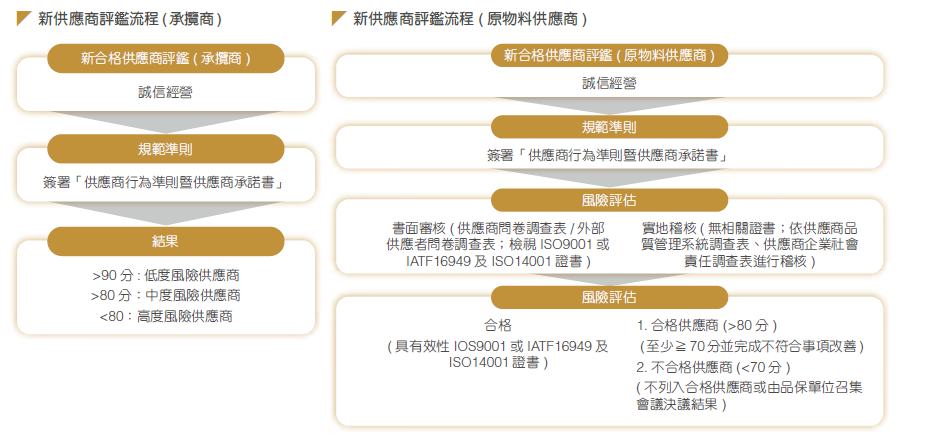
SAS suppliers are subject to supplier evaluation processes according to the categories of raw materials, engineering contractors, and non-engineering contractors. When a new supplier is established, an integrity management review is conducted, and the supplier is required to sign the “Supplier Code of Conduct & Supplier’s Declaration.” For raw material suppliers, third-party certifications for environmental and quality systems are further required; if such certifications are not available, on-site audits will be conducted jointly with units such as quality assurance, R&D, production, or environmental protection personnel.
- Ongoing Evaluation Process for Qualified Suppliers
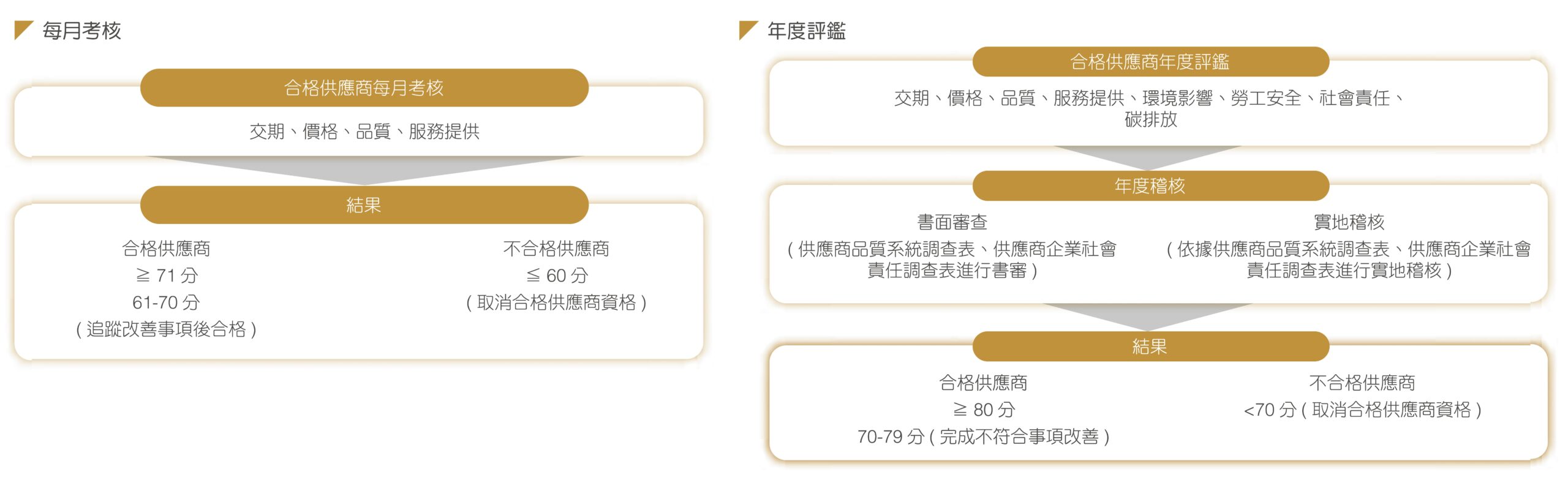
Under SAS’s supplier management system, all qualified raw material suppliers are evaluated monthly based on quality, delivery, cost, and service. For key raw material suppliers, procurement cost, environmental impact, social responsibility, and quality improvement needs are incorporated into the annual evaluation criteria. Annual evaluations are conducted through document reviews or on-site audits to ensure that delivery quality meets requirements and to continuously improve suppliers’ sustainability management.
▼既有供應商考核流程
SAS has established a supplier management framework that incorporates sustainability considerations into its supplier evaluation and assessment processes. Key sustainability topics, including environmental protection, labor and human rights, occupational health and safety, business ethics, product quality, and regulatory compliance, are integrated into four major audit dimensions. Through annual supplier evaluations and audit activities, the Company continuously monitors suppliers’ sustainability performance and works collaboratively with its suppliers to enhance the sustainability and competitiveness of the supply chain.
- Four Key Audit Dimensions
- Evaluate whether the supplier complies with government environmental regulations, including requirements related to air pollutant emissions, water resource management, and waste disposal.
- Confirm whether its products and raw materials comply with green procurement standards, such as RoHS, REACH, WEEE, and others.
- Review whether the supplier has obtained valid certification for the ISO 14001 environmental management system to ensure that its environmental management has systematic and continuous improvement capabilities.
- Evaluate whether the supplier complies with the social responsibility and labor human rights management requirements stipulated in the Responsible Business Alliance Code of Conduct (RBA), including the prohibition of forced labor and child labor.
- Do not procure metals produced in conflict-affected areas, and require suppliers and their upstream supply chains not to procure or use conflict minerals.
- Review whether the supplier complies with the principles of fair trade and ethical business conduct, and meets SAS’s relevant anti-corruption requirements.
- Ensure that the products and services provided by the supplier do not raise concerns regarding infringement of intellectual property rights, and that the supplier complies with relevant trade systems and regulatory requirements.
- Confirm whether the supplier has obtained valid certification for the ISO 9001 quality management system.
- Review whether the supplier’s process management complies with established quality management requirements to ensure product quality stability.
相關文件
下載
SAS continues to promote supply chain localization to enhance supply chain resilience and fulfill its sustainability commitments. By prioritizing local suppliers, the Company can shorten material transportation distances, reduce logistics costs and inventory carrying requirements, improve supply flexibility, and avoid unnecessary environmental impacts. In addition, upholding the concept of green procurement, the Company gives priority to products with low energy consumption and products certified by the Ministry of Environment in order to reduce energy consumption, lessen environmental burdens, promote the development of green industries, and drive local employment.
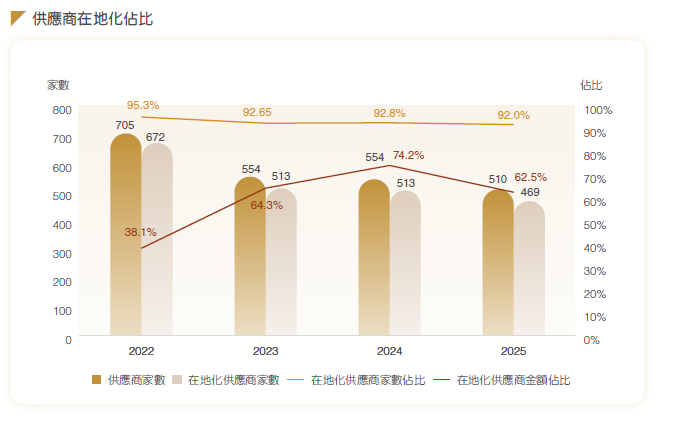
In 2025, SAS had a total of 510 suppliers, of which 470 were local suppliers, accounting for 92.2%; the local procurement amount accounted for 62.5% of the total procurement amount. Key raw materials for daily operations include silicon raw materials, dopants, silicon wafers, and conductive paste. Due to geographical constraints and the economies of scale of the international supply chain, such products cannot all be sourced from Taiwan. To strengthen the diversified supply of key raw material sources, for key raw material suppliers, the Company continues to evaluate the introduction of second-source suppliers based on product characteristics, the degree of supply risk, and actual operational needs, in order to reduce the risk of supply chain disruption. At present, the evaluation or introduction of second sources has been completed for some key raw materials; however, due to requirements related to product mix, process compatibility, and customer certification for certain key raw materials, quality testing and customer approval are still required, and therefore full introduction is not yet possible.
Excluding silicon raw materials and silicon wafers that cannot be sourced locally, among the procurement of other items, the proportion of local procurement amount increased to 83.9% (calculated based on the procurement amount excluding silicon raw materials and silicon wafers), indicating that the Company has achieved a high proportion of local procurement for other items.
SAS is committed to responsible sourcing and prohibits the procurement or use of minerals and derivative metals that directly or indirectly finance armed groups, contribute to conflict, are associated with severe human rights violations, or violate internationally recognized ethical standards.
We require our suppliers to comply with the Responsible Business Alliance (RBA) Code of Conduct and the requirements of the Responsible Minerals Initiative (RMI) by establishing mineral source traceability and due diligence mechanisms. Suppliers are also required to regularly provide information regarding the origin of minerals to verify that the minerals used throughout the supply chain are sourced from smelters and refiners that adhere to responsible mining principles.
SAS continuously evaluates supply chain risks and collaborates closely with suppliers to promote responsible minerals management. Through these efforts, we are committed to building a transparent, accountable, and sustainable supply chain.
【Supplier Code of Conduct】Conflict-Free Minerals
- Supplier shall recognize that armed rebel organizations in the Democratic Republic of the Congo (DRC) and its surrounding regions operate through metal mining and trading invoke serious social and environmental problems, including human right violations, armed conflict, and international disputes.
- As a corporate citizen responsible for protecting human rights and ameliorating armed conflicts in DRC and its surrounding regions, Supplier is required to take due diligence within its supply chain to assure “Conflict-Free Minerals” with respect to gold (Au), tantalum (Ta), tungsten (W), tin (Sn), cobalt (Co), mica used in its products sold, transferred or delivered to Buyer are not derived from or sourced from the foregoing areas.
- Supplier shall acknowledge that areas not confirmed to be “Conflict-Free Minerals” include direct exports from the DRC, as well as exports through Angola, Burundi, Central African Republic, Republic of Congo, Rwanda, South Sudan, Zimbabwe, Uganda, Tanzania, Kenya, and Zambia (countries of whom the U.N. Security Council note are global export routes for DRC-mined minerals).
- Supplier shall adopt a policy and exercise due diligence on the source and management of the gold (Au), tantalum (Ta), tungsten (W), tin (Sn), cobalt (Co), mica in the products they manufacture in a way consistent with the “Organization for Economic Co-operation and Development (OECD) Guidance for Responsible Supply Chains of Minerals from Conflict- Affected and High-Risk Areas” due diligence framework to assure that such minerals are conflict-free.
- If the products provided by Supplier involve usage of gold (Au), tantalum (Ta), tungsten (W), tin (Sn), cobalt (Co), or mica as raw materials, Supplier shall complete and submit to Buyer the Conflict Minerals Reporting Template (CMRT) or Extended Minerals Reporting Template (EMRT), which may be downloaded from the RMI website:
https://www.responsiblemineralsinitiative.org/reporting-templates/cmrt/
https://www.responsiblemineralsinitiative.org/reporting-templates/emrt/
【Supplier Code of Conduct】Green Procurement
Supplier shall fulfill its responsibilities as a global citizen by carrying out green procurement, and requiring its next-tier suppliers to cooperate with the following principles:
- The supplied products/goods shall comply with applicable environmental laws both domestically and abroad (such as RoHS, REACH and WEEE).
- Prioritize the procurement of products designated with officially recognized Green Label (e.g., Energy Saving, Water Saving, Green Building Materials).
- Supplier shall submit relevant test reports issued by an impartial third-party to assure the compliance with nonuse of hazardous substances when necessary.