
Sustainable Environment
Climate Change Risks and Actions
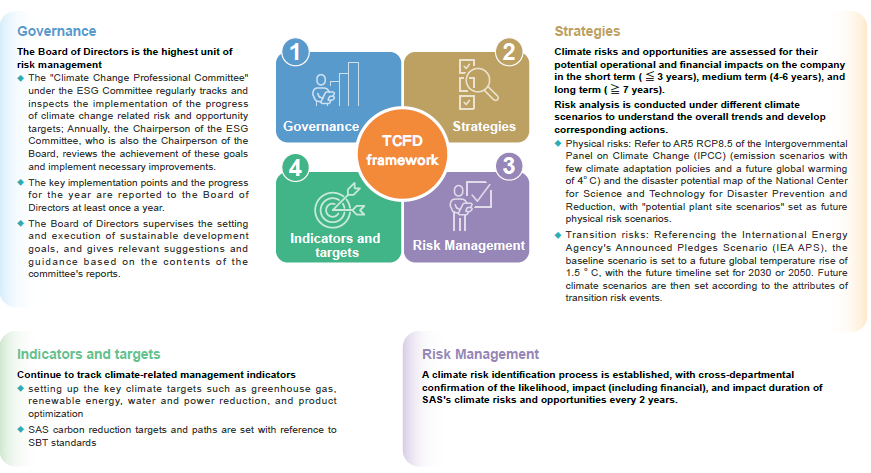
Driven by the pressure of frequent extreme climate events globally and the transition to a low carbon market, SAS is actively addressing the potential risks and opportunities brought by climate change. We refer to the Task Force on Climate-related Financial Disclosures (TCFD) to develop our own climate change risk and opportunity assessment process. Through relevant departments, we collect information on current and emerging policies and regulations, technological and market changes, reputational and physical risks, and execute climate risk and opportunity assessments. This approach aims to understand changes in the external environment and market dynamics, considering the Company’s overall operational strategy planning.
Carbon Emission Management
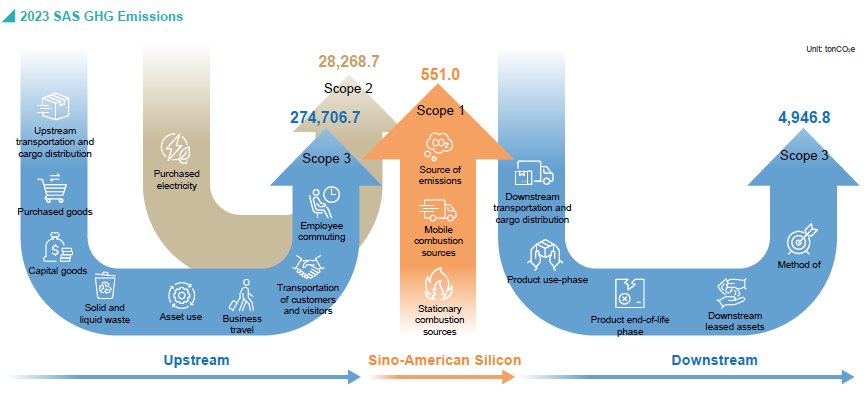
Since 2021, SAS has gradually promoted and completed the systematic GHG emissio ns inventory (ISO 14064-1: 2018) and inventory creation. The reporting boundaries include: the headquarters, Chunan Branch, Yilan Branch, and Hsu-Hsin Branch, wit h 2022 as the baseline year. Each year the greenhouse gas emissions of each plant ar e regularly inventoried and verified by a third party to comprehensivel y understand the emission status and validate the effectiveness of reduction actions. SAS’ Chunan and Yilan branches have adopted the “operational control method” as their organiza tion boundary setting. Greenhouse gas emissions related to organizational operation s include direct (Scope 1, direc t GHG emissions), energy indirect (Scope 2, indirect GHG emissions from imported energy), and other indirect GHG emission sources (Scope 3 to Scope 6). Our greenhouse gasemissions calculations were based on the 7 greenhouse gases defined by the ISO 14064-1 standard: carbon dioxide (CO2), meth ane (CH4), nitrous oxide (N2O), hydrofluorocarbons (HFCs), perfluorocarbons (PFC s), sulfur hexafluorid e (SF6), and nitrogen trifluoride (NF3). We have primarily ado pted the “emission coefficient method.” The emission factors referenced are from the EPA’s GHG Emission Factor Management Table version 6.0.4, the EPA Carbon Foo tprint Calculation Service Platform, the Industrial Technology Research Institute’s DoITPro database, and relevant literature. The Global Warming Potential (GWP) va lues used in the calculation process by Sino-American Silicon Products Inc. (SAS) ar e referenced from the IPCC AR5 (2013) GWP values. The greenhouse gases produced include CO2, CH4, N2O, and HFCs, with no greenhouse gas emissions from perfluor inated compounds.
Energy Management
Most of the past energy-conservation improvements in the factories were onetime improvement efforts, which may not maximize the energy-saving effect due to the lack of an appropriate management mechanism. Thus, since 2021, SAS has gradually implemented an Energy Management System (ISO 50001:2018) in its production facilities. Both the Chunan and Yilan branches have established a systematic PDCA management cycle that inventories equipment energy usage in the factory to identify major energy-using equipment, prioritizes equipment improvement, monitors the measurements, and adopts appropriate improvement actions. Moreover, it helps set corresponding energy baselines and energy performance indicators according to the factory characteristics and energy use identification results as well as continues to update, monitor, and review their reasonableness each month to continuously improve energy efficiency.
Renewable Energy Layout
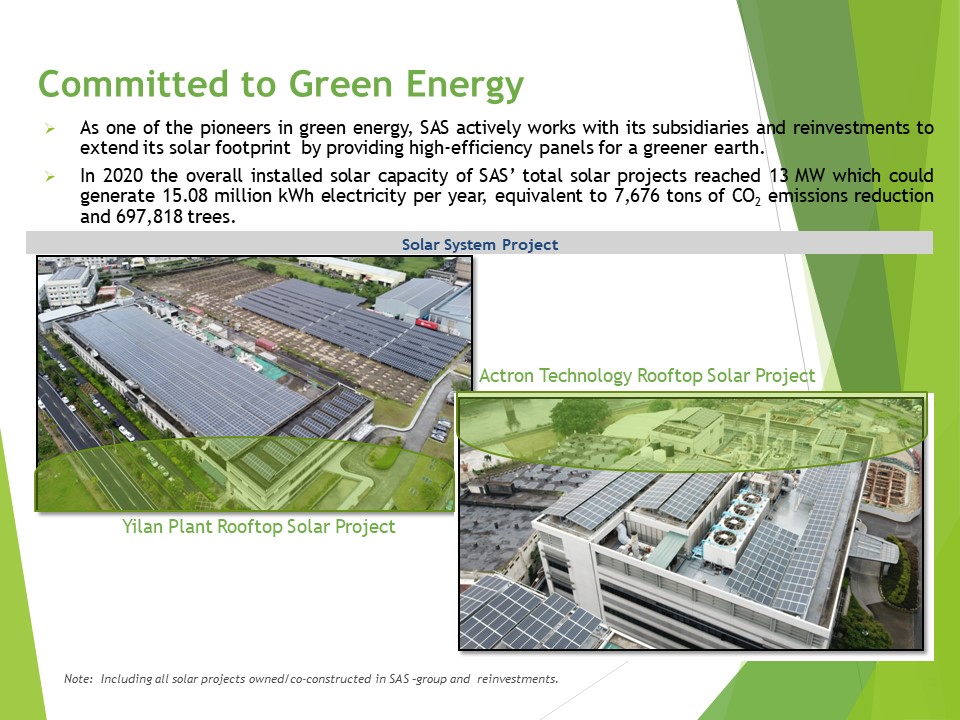
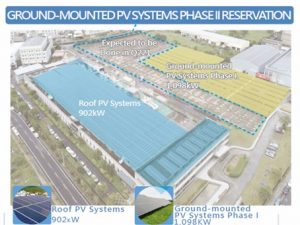
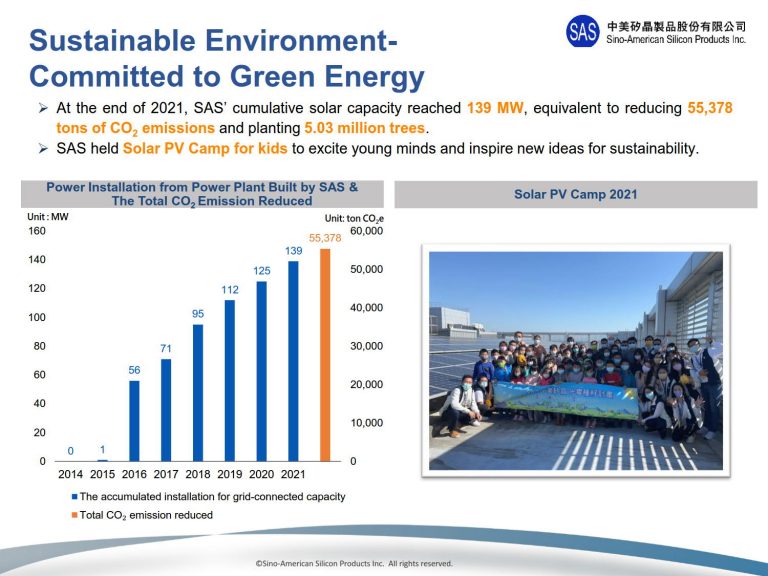
SAS has continued to pay attention to the various climate action plans after the Paris Agreement, and TSMC has joined RE100. SAS knows that the construction and use of renewable energy is a necessary and important method for companies to achieve SBT reduction goals. In terms of strategic layout, SAS has deployed its Hsu-Hsin Branch and Yilan Branch (which established the Power Station Development Department in 2020) to fully enter Taiwan’s renewable energy market by actively planning and investing in the construction of roof-, ground-, and water-surface-type solar power plants. The Company has also introduced a water surface buoyancy solar power generation system to lower the water surface temperature and significantly increase the solar panel as well as power generation efficiency. From the beginning (2014) to the end of 2023, the total solar power generation system installation capacity at home and abroad for grid-connected operation is approximately 158.4 MW, with a total annual power generation capacity of 183,937,696 kWh and an estimated carbon dioxide emission reduction of approximately 91,049 metric tons Note. Furthermore, in response to the government’s active promotion of renewable energy, the goal is to complete 20 GW of solar energy installations by 2025. SAS has remained committed to both providing energy management-related services and investing in the construction of solar power plants since 2019.We have stepped up to become a provider of green energy. In 2023, we collaborated with Hitachi Air Conditioner to plan to install a solar power system with a total installed capacity of 9.6MW at the “Hitachi Air conditioner Taoyuan Factory”, the largest air conditioner manufacturer in Taiwan, of which 7MW has been paralleled with Taiwan Power Company officially put into operation.
Water Use and Discharge
SAS’s plants in Taiwan use tap water supplied by the Taiwan Water Corporation and ground surface water; underground water is not utilised. As a result, issues such as underground water overuse, land subsidence, or ecological impact from groundwater extraction do not apply. For water resources, Chunan Branch receives water from Dongxing Purification Plant with Yongheshan Reservoir as its raw water source. Yilin Branch obtains water from Longde Purification Plant, using Sincheng River as its raw water source. Neither water source is categorised as a national or international nature reserve or identified as originating from sensitive areas (as assessed by experts for specific regional attributes, functions, rarity, threat levels, endangered systems, or endangered species inhabiting the source).
To further understand water stress and usage risks at each site, SAS adopted the WRI Aqueduct Water Risk Atlas, developed by the World Resources Institute, to assess water-related risks across its operations. Taiwan’s overall water resource risk is rated at 1~2 (low to medium risk) and is not classified as a high water stress area. SAS does not draw, discharge, or consume water from regions identified as having high water resource stress.
In recent years, extreme weather events have contributed to increasingly unpredictable rainfall patterns in Taiwan, impacting overall water supply reliability and presenting heightened challenges for industrial water management. The Company does not use ultrapure water in its operations. Nevertheless, it continues to advance water conservation and efficient water reuse through process optimization and water recycling technologies, thereby reducing production’s reliance on freshwater. In 2024, these initiatives achieved total water savings of 110.95 million liters, demonstrating the Company’s ongoing commitment to sustainable water resource management.
The Company currently operates only two production facilities: the Chunan Plant and The Sustainable Sunrise subsidiary. In 2025, the Chunan Plant achieved 100% compliance with discharge standards and maintained COD and SS removal rates above 80%. The Sustainable Sunrise subsidiary reduced hydrofluoric acid (HF) usage by approximately 20–30%, improved wastewater treatment performance, and reduced biological sludge by 90% compared with the previous year.
In 2026, the Chunan Plant aims to maintain 100% compliance with discharge standards, achieve COD and SS removal rates of at least 85%, and increase the process water recycling rate to over 80%, equivalent to approximately 19,272 m³ annually. The Sustainable Sunrise subsidiary will further reduce chemical usage, strengthen wastewater quality management, and reduce wastewater sludge through process improvements.